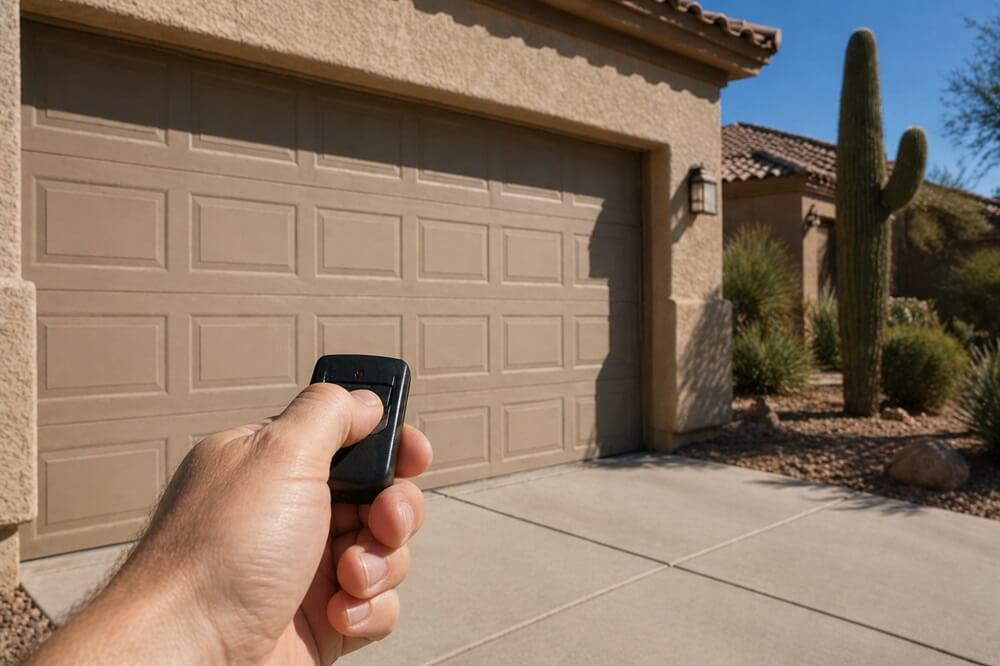
If you are pulling into your driveway in Mesa and your garage door remote is suddenly unresponsive, you aren’t alone. In the East Valley, “remote failure” is rarely just about a dead battery; it is usually a direct result of our extreme climate taxing the electronic components of your opener system.
Same-Day Garage Door Opener Repair in Mesa
Don’t get stuck in the Arizona sun waiting for your door to open. Our Mesa-based technicians specialize in heat-damaged electronics, logic board replacements, and signal interference troubleshooting. We offer rapid response times to neighborhoods from Dobson Ranch to Las Sendas.
The “Desert Remote” Checklist
- Sun Glare: If the door closes but won’t open via remote during the afternoon, the sun is likely “blinding” your safety sensors.
- Battery Swelling: 115°F+ heat can cause lithium batteries to leak or swell, losing contact with the remote terminals.
- Fried Logic Board: Excessive heat in the garage attic space can bake the receiver’s circuit board, leading to intermittent signal loss.
- LED Interference: Cheap LED bulbs installed in the opener can put out a frequency that “jams” your remote signal.
What’s Happening?
When your garage door remote fails in Mesa, the issue is typically a breakdown in the communication between the handheld transmitter and the motor’s logic board. Inside that plastic remote casing, sensitive circuitry is being subjected to extreme thermal expansion. During a Mesa summer, the interior of a closed garage can easily exceed 140°F. This heat causes the solder joints on the circuit board to expand and contract, eventually leading to “cold solder joints” or micro-fractures that kill the signal.
The Arizona Factor: Heat, Dust, and Frequency
In Arizona, we deal with three specific “Remote Killers”:
- Thermal Battery Drain: Standard alkaline batteries don’t stand a chance against the Mesa heat. High temperatures accelerate the chemical reaction inside the battery, leading to a much shorter lifespan than the “3-year” estimate printed on the box.
- Monsoon Dust Intrusion: Fine desert silt from our haboobs can find its way inside the remote casing or the opener’s antenna wire. This dust acts as an insulator, physically blocking the buttons from making a clean connection on the contact pad.
- Signal “Ghosting” from Sun Glare: In neighborhoods like Eastmark, many homes face East/West. When the afternoon sun hits the safety sensors at the base of your door, it can “overpower” the infrared beam. The system thinks there is an obstruction and refuses to let the remote trigger the closing cycle.
Symptom → Cause → Risk Level
| Symptom |
Likely Arizona Cause |
Risk Level |
| Remote works only when 2 feet away |
Weak battery or shortened antenna due to heat |
|
| Wall button works, but all remotes fail |
Fried Logic Board / Receiver |
Medium (Part replacement needed)
|
| Remote won’t close door in the afternoon |
Sun glare “blinding” photo-eyes |
|
| Remote light blinks, but no door movement |
Stripped internal gear or capacitor failure |
|
🚨
Stuck in Mesa right now?
Don’t let a malfunctioning remote ruin your day or leave your home vulnerable. Our techs are in your neighborhood and ready to sync, repair, or replace your system today.
What You Can (and Can’t) Check Safely
The 10-Second Visual Check
- Check the “Lock” Button: On your wall-mounted station in the garage, check if the “Lock” or “Vacation” mode is engaged. This is the #1 reason remotes “suddenly” stop working in Mesa.
- Wipe the Eyes: Use a clean cloth to wipe the dust off the safety sensors at the bottom of the tracks.
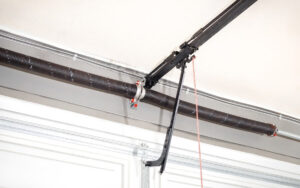
- The Antenna Hang: Look at the motor head. There should be a small purple, wire, or grey wire hanging down. If it’s tucked up inside the motor cover, the heat might be causing the signal to be shielded by the metal housing.
The Professional Boundary
Do not attempt to open the motor casing or mess with the logic board yourself. In the desert, these components become brittle. One wrong move with a screwdriver can crack a heat-weakened plastic housing or cause a short in the capacitor. Most importantly, never touch the torsion springs above the door if you are trying to manually override the system; those are under thousands of pounds of pressure.
Why Mesa Homeowners Struggle With Opener Electronics
The desert climate is a slow-motion wrecking ball for electronics. While a garage door opener might last 15 years in a temperate climate, the Mesa heat typically limits the “electronic life” to 8–10 years. The plastic components of the remote buttons also become “tacky” or brittle over time due to UV exposure, especially if you leave your remote clipped to your visor in the sun.
Component Longevity Table
| Component |
Standard Life |
Arizona Life |
| Remote Battery |
2–3 Years |
1 Year |
| Opener Logic Board |
12–15 Years |
8–10 Years |
| Safety Sensors |
10 Years |
5–7 Years (UV damage) |
| Remote Casing |
10+ Years |
4–5 Years (Brittle plastic) |
If you’ve swapped the batteries and your remote is still giving you the silent treatment, it’s time for a professional diagnostic. The Arizona sun is relentless—don’t let a small electronic glitch turn into a total system failure.
Call a local Mesa expert today to get your door moving again.
Expert Quote:
Here is a golden nugget from 20 years in the Mesa heat: Move your remote. Most people leave their garage remote clipped to the sun visor. In Arizona, that visor acts like a heat-sink, baking the remote’s internals at 150°F+ against the windshield. Keep your remote in the center console or a door pocket out of direct sunlight. Also, if your remote is acting up, check your light bulbs. If you recently put a “cheap” LED bulb in the opener, it emits RFI (Radio Frequency Interference) that can effectively jam your remote signal. Switch to an ‘Appliance Rated’ or ‘Garage Door Specific’ LED to fix it instantly.
FAQ