
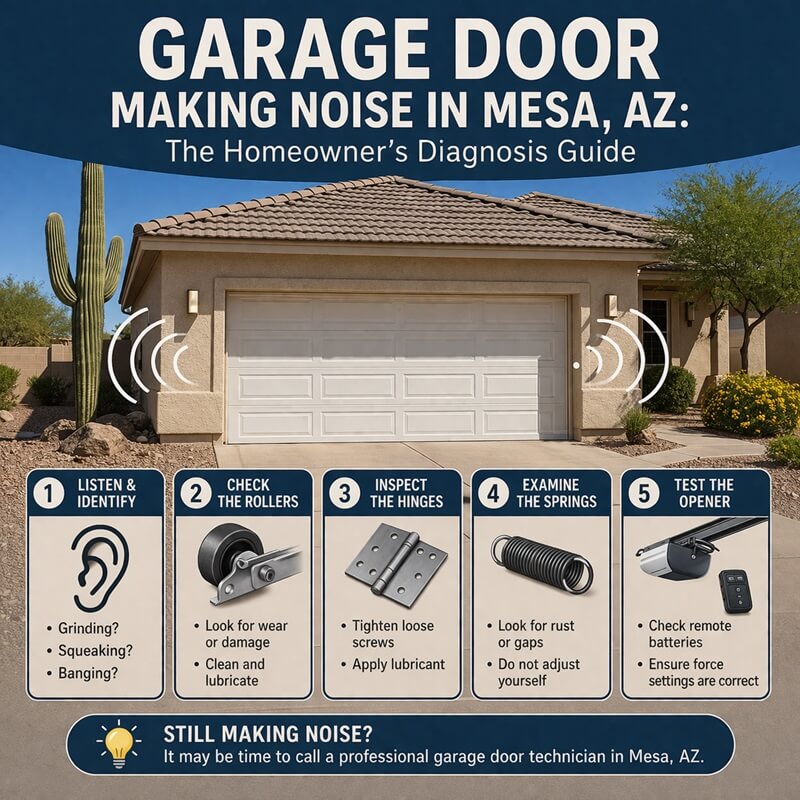
If your garage door sounds like a train wreck every time you hit the button, you aren’t alone. In Mesa, the combination of aging hardware and our brutal desert climate creates a perfect storm for noisy operations. This guide breaks down exactly what those rattles, squeaks, and bangs mean and how to silence them before a small noise turns into a total system failure.
Is your noisy garage door waking up the neighbors in Orange Tree or Las Sendas? Don’t let a squeak turn into a snapped cable. Our Mesa-based technicians specialize in silencing desert-worn doors with heavy-duty parts designed for Arizona heat.
A garage door is a complex system of moving parts under extreme tension. When one part starts making noise, it’s usually a “cry for help” from a bearing, a roller, or a spring. In a perfect world, your door should move with a steady, low-frequency hum. If you start hearing sharp, metallic, or inconsistent noises, the friction in your system has reached a critical point.
Symptom → Cause → What It Means
| Symptom | Likely Cause | Risk Level |
| Vibrating Rattles | Loose nuts and bolts on the hinges or tracks. | Low – Easy to tighten, but annoying. |
| Squeaking/Chirping | Dry rollers or pulleys. | Medium – Leads to premature wear. |
| Grinding/Scraping | Steel rollers “sliding” instead of rolling. | High – Can burn out your opener motor. |
| Loud Bang | Torsion spring failure. | Extreme – Do not operate the door. |
A noisy door is often the final warning before a door gets stuck halfway—usually when you’re already late for work or coming home late at night. If your door is shaking or making “death rattles,” it’s putting massive strain on your expensive opener motor. Save the motor and fix the hardware now. (478) 330-3574
🚫 WARNING: Never touch the red-colored bolts, the bottom fixtures, or the springs. These are under enough tension to cause severe injury.
If the noise is a grinding sound or a heavy thumping, it’s time to call a tech. This usually indicates that the bearings inside your rollers or the end-bearing plates (which hold the weight of the entire door) are failing. Replacing these requires specialized tools to unwind the springs safely.
Ignoring a noisy door is a gamble. Constant vibration loosens the hardware until a roller pops out of the track (an “off-track” event). When this happens, the door can hang precariously, potentially falling or crushing the tracks. Furthermore, a high-friction door will burn out your garage door opener’s gears, turning a $150 maintenance job into a $600 replacement.
| Component | Standard Lifespan | Arizona Reality (Mesa Heat/Dust) |
| Plastic Rollers | 3-5 Years | 2 Years (Brittle from heat) |
| Nylon Rollers (Sealed) | 10-12 Years | 7-9 Years |
| Lubrication | 12 Months | 6 Months (Due to dust/evaporation) |
| Steel Tracks | 20+ Years | 15 Years (Rust from monsoon humidity) |
If your door is screaming for attention in Mesa, it’s usually faster and cheaper to fix it early. A quick professional service can add years to your door’s life and give you back your peace and quiet.
No. Never grease the inside of the tracks. Grease traps dust and hair, causing the rollers to slide and flatten. Only lubricate the moving bearings and hinges.
A professional “Tune-up and Lube” is usually the most affordable service call, often preventing much more expensive repairs.
Yes, significantly. If you live in a quiet neighborhood like Alta Mesa, switching to high-cycle sealed nylon rollers is the best way to make your door “whisper quiet.”
Yes, we provide same-day and emergency services throughout the East Valley.
Enter your ZIP code to see if our experts are in your area.