
Is your garage door refusing to close? Are the lights on your opener flashing ten times? In the Arizona heat, a garage door that won’t shut isn’t just a nuisance—it’s a security risk and an invitation for pests and dust storms to enter your home. Our technicians are standing by to provide same-day emergency sensor alignment and replacement across the Valley.
As an expert with two decades of experience under the Arizona sun, I can tell you that the Phoenix climate is a “torture chamber” for garage door electronics. While homeowners in cooler climates worry about snow blocking their sensors, we deal with thermal expansion and infrared saturation.
Garage door safety sensors (photo-eyes) operate using an invisible infrared beam. The “sending” sensor emits a light signal, and the “receiving” sensor catches it. When the sun hangs low in the Arizona sky—specifically during our brutal summer afternoons—the raw intensity of the sunlight can overpower the infrared signal.
The receiving sensor becomes “blinded” by the ambient UV radiation, interpreting the sunlight as a signal disruption. This triggers the safety reversal mechanism, causing your door to stop and reverse even when nothing is in the way.
In temperatures exceeding 110°F, the metal tracks and mounting brackets of your garage door system expand. In Phoenix, many garages are uninsulated, reaching internal temperatures of 130°F+. This heat causes minute shifts in the metalwork. A sensor that was perfectly aligned in the cool of February may be millimeters out of alignment by July, breaking the safety circuit.
Before you call a technician, there are several technical checks you can perform yourself.
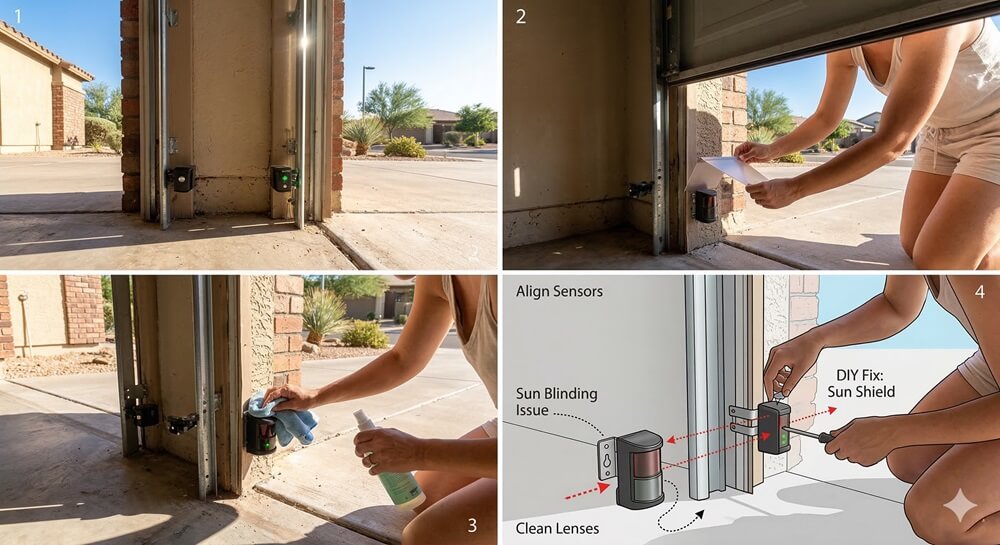
If your door closes fine at night but fails during the day, you have a sun-blindness issue. A pro trick I’ve used for years involves taking a small piece of dark cardboard (like a toilet paper roll) and taping it around the receiving sensor to create a “sun-hood.” This shades the lens, allowing it to “see” the infrared beam from the sender without being washed out by the Arizona sun.
In the Phoenix Metropolitan Area, haboobs (dust storms) are a regular occurrence. Fine desert silt coats the glass lens of the photo-eye. Use a microfiber cloth and a gentle glass cleaner to wipe the lenses. Do not use abrasive chemicals, as micro-scratches can further scatter the infrared light.
If cleaning and alignment don’t work, the problem likely lies in the low-voltage wiring.
Arizona’s extreme dry heat causes the plastic insulation on bell wire (the thin wire connecting sensors to the motor) to become brittle over time. This leads to “cracking,” where the copper becomes exposed. During monsoon season, even a tiny amount of humidity can cause a short circuit in these exposed wires.
Sometimes the sensors are fine, but the opener gear or the logic board is failing to process the safety signal. If your motor makes a clicking sound or the light bulbs flash but the door doesn’t move at all, the issue may be internal to the motor unit. In our region, power surges during summer thunderstorms frequently fry the sensitive capacitors on these boards.
When mounting your sensors in a Phoenix garage, I always recommend slightly recessing them further back into the garage, away from the door track, and tilting the receiving sensor about 5 to 10 degrees inward. This ensures that even when the tracks expand from the heat, the “sweet spot” of the infrared beam remains wide enough to maintain a solid connection.
Don’t leave your garage door open and your home exposed to the Arizona elements. If you’re struggling with “sun-blinded” sensors or faulty wiring, our Phoenix-based experts can have your door running smoothly and safely today.
Absolutely not. Modern openers (manufactured after 1993) require a pulsed signal from the sensors. Simply twisting the wires will not work, and bypassing safety features is a major liability and safety hazard.
Industry standards and Arizona building codes typically require sensors to be mounted no higher than 6 inches above the garage floor. This ensures the beam can detect small children or pets.
While they won’t “melt” into a puddle, the plastic casings can warp. More importantly, the internal infrared diode can degrade faster when exposed to constant 120°F+ temperatures inside a closed garage.
Check your “Force Settings” on the back of the opener. In the summer, the lubricant on your tracks can thin out or dry up, causing the motor to think it has hit an obstruction. You may need to adjust the travel force or lubricate your rollers.
Enter your ZIP code to see if our experts are in your area.